
Wagner Die Walküre
Sunday 25 January 2026 - 15 h
Tuesday 27 January 2026 - 19 h
Thursday 29 January 2026 - 19 h
Act I: 55 min | Intermission: 25 min | Act II: 1h25 | Intermission: 20 min | Act III: 1h
Opera in three acts
Music by Richard Wagner (1813-1883)
Libretto by Richard Wagner
Premiere: Munich, Royal Theatre, 26 June 1870
New production
In this part of Wagner’s Tetralogy, we witness the consequence of what had happened in Das Rheingold: the ring, which Godfather Wotan in his greed for supremacy stole from Alberich, brings more fatal destruction. At the end of the opera, Wotan remains a broken man who lost the respect of his wife, banished his favourite daughter, provoked the death of his beloved children, and forsakes his godly might.
Three imposing female figures dominate Die Walküre: at first the human girl Sieglinde, who manages to break away from her violent husband Hunding with the help of Siegmund, an unknown boy. She falls in love and conceives a child with him – only to find out that he is her lost twin and like her an illegitimate child of Wotan’s. The second act contains a magnificent confrontation between Wotan and his wife Fricka, where she argues him into bowing to laws more universal than any god’s power. We also meet Brünnhilde, whose future unfolds before us in the rest of the Ring. A careless tomboy at first, she matures into a compassionate, heartful woman, who unhesitatingly faces expulsion from Valhalla and loss of her deity, the harsh punishment for helping Siegmund and Sieglinde in their darkest hour.
Videos


Gianluca Capuano
Italian conductor Gianluca Capuano has been Principal Conductor of Les Musiciens du Prince – Monaco since 2019. The ensemble was founded by Cecilia Bartoli, with whom he enjoys a close artistic collaboration. He studied organ, composition and conducting at the Milan Conservatory, and pursued early music studies at the Scuola Civica in the same city. Holding a degree in theoretical philosophy from the University of Milan, he also engages in research on musical aesthetics. In 2006, he founded Il Canto di Orfeo, a vocal ensemble with which he has performed La morte d’Abel at the Salzburg Festival, La clemenza di Tito on tour and at the 2023 Whitsun Festival. Since their Norma in 2016, he has regularly conducted Cecilia Bartoli and Les Musiciens du Prince in Salzburg, Vienna, Zurich, Amsterdam, Luxembourg and Paris. Among his notable engagements are: Catone in Utica, Il matrimonio segreto, and Gli uccellatori in Cologne; Guillaume Tell in Orange; Iphigénie en Tauride and Orlando paladino in Zurich; Il barbiere di Siviglia in Palermo and Vienna; Idomeneo at the Maggio Musicale Fiorentino, Stabat Mater by Pergolesi in Lucerne ; and La cenerentola at La Scala in Milan . He conducted the first two albums in the “Mentored by Bartoli” collection for Decca. In 2022, he was awarded the Premio Abbiati for Conductor of the Year. At the Opéra de Monte-Carlo, he has conducted La Cenerentola, Il turco in Italia, Giulio Cesare, Ariodante, Ein deutsches Requiem, Their Master’s Voice, La donna del lago, Alcina, Il barbiere di Siviglia, La clemenza di Tito, Das Rheingold and Vespro della Beata Vergine.

Davide Livermore
Davide Livermore has built an outstanding career spanning over two decades, both on major European stages and in theatres across his native Italy. Outside Europe, he has worked at the Philadelphia Opera, Tokyo’s Bunka Kaikan, and the Seoul Arts Center. He maintains a long-standing collaboration with Milan’s Teatro alla Scala, where he has opened several seasons with Attila (2018), Tosca (2019), A riveder le stelle (2020), and Macbeth (2021). At the Opéra de Monte-Carlo, he has directed Adriana Lecouvreur (2017), the world premiere of Caruso a Monaco with Jonas Kaufmann (2023), Don Carlo (2023), Giulio Cesare (2024), Das Rheingold, Aida and Bonsoir Monte-Carlo (2025). In addition to his stage work, he served as General Manager and Artistic Director of the Palau de les Arts Reina Sofía in Valencia and is currently Artistic Director of Genova’s Teatro Nazionale. He has taught stage direction and design at the IUAV University in Venice and headed Performing Arts School at the Teatro Stabile in Turin. In April 2025, his original project D’oro – Il sesto senso partigiano was presented in Rome in the presence of the President of the Italian Republic. He also recently directed the film The Opera! – Arias for an Eclipse, premiered at the Rome Film Festival. He is an Officer of the Order of the Star of Italy and a recipient of the Eschilo d’Oro Prize for his stagings at the Syracuse Festival.

Eleonora Peronetti
Italian set and costume designer Eleonora Peronetti works in opera, dance, fashion and video. After studying scenography at NABA (Milan), she worked closely with Margherita Palli as assistant designer, both on stage and for major exhibitions. She collaborates today with leading Italian theatres, notably La Scala in Milan: The Nutcracker choreographed by George Balanchine (2018), Khovanshchina (2019), Rigoletto (2022) and Fedora (2022) in productions by Mario Martone. She is a regular collaborator of Giò Forma on David Livermore’s productions such as Tosca (2019) and Macbeth (2021) at La Scala, La traviata (2021) in Florence and Giovanna d’Arco (2021) in Rome. In 2024, she co-designed La lupa / Il berretto a sonagli in Catania, Turandot at La Scala, Die Walküre in Beijing and Khan Sultan in Almaty. Since 2019, she has designed costumes for choreographer Angelin Preljocaj: Winterreise, Birthday Party, Torpeur and Requiem(s), presented in 2024–2025 in Caen, Sceaux, Versailles, Cremona, Rouen, Athens, Salzburg and Madrid. She also creates sets for fashion events (Canali, Fila, Sergio Rossi, Sisley, Aigner). Her work combines technical precision with imaginative flair. At the Opéra de Monte-Carlo, she designed the sets for Das Rheingold in 2025 with Davide Livermore and Paolo Gep Cucco (D-Wok).

Gianluca Falaschi
Gianluca Falaschi was born in Rome. He has worked in various Italian and international theatres, including Teatro alla Scala in Milan, Teatro dell’Opera in Rome, Teatro Municipal in São Paulo, the Sydney Opera House and Palau de les Arts in Valencia. In his long-standing collaboration with Davide Livermore, he has designed over thirty productions, including three season openings at La Scala: Attila, Tosca and Macbeth. He has also created costumes for several operas at the Rossini Opera Festival in Pesaro, winning the Abbiati Prize for Best Costume Designer for Ciro in Babilonia in 2013. His close collaboration with Lydia Steier includes Les Troyens in Dresden, Carmen in Cologne, Perelà by Dusapin and Armide by Gluck in Mainz, for which he was named Costume Designer of the Year in 2015 and 2017 by Opernwelt. In 2024, he made his house debut at Zurich Opera (The Merry Widow) and at Vienna State Opera (Così fan tutte), both productions directed by Barrie Kosky. In ballet, he created sets and costumes for The Wizard of Oz in Florence, later taken up by the New Zealand Royal Ballet. Since 2021, he has expanded into stage direction with Angelica by Porpora, Adriana Lecouvreur, Griselda, I Capuleti e i Montecchi, and Chiara e Serafina. In Monte Carlo, he designed the costumes for Adriana Lecouvreur (2017), Das Rheingold, Aida and Bonsoir Monte-Carlo (2025).

Antonio Castro
Born in Cambil-Jaén, Andalusia, Antonio Castro began his career in lighting after training in electrical engineering, working at the Teatro Cánovas in Málaga. He soon collaborated with various companies, first as a technician and later as a lighting designer for theatre, dance, and music productions. He has worked with the Málaga School of Dramatic Art, the Conservatory of Dance, and the Escénica performing arts centre. Since 2006, he has been resident lighting designer at the Palau de les Arts Reina Sofía in Valencia, where he designs lighting for numerous productions while continuing freelance work. He has created the lighting for several Centre de Perfeccionament productions, including Le nozze di Figaro, Dido and Aeneas, Juditha Triumphans, Silla, Bastien und Bastienne, and Il tutore burlato, and has worked on opera productions such as Otello, Norma, Don Giovanni, Madama Butterfly, Tosca, Luisa Fernanda, Rigoletto, Aida, Les Contes d’Hoffmann, Macbeth, La Gioconda, and La forza del destino, which earned the Campoamor Award in 2014. At the Opéra de Monte-Carlo, he has designed the lighting for The Telephone and Amelia al ballo (2013/2014), Caruso a Monaco, Don Carlo, Giulio Cesare (2023/2024), Das Rheingold (2024/2025), Aida and Bonsoir Monte-Carlo this season.

D-Wok
D-wok is a creative studio specialized in performance design, innovative stage formats, event production, and advanced video design systems. For over a decade, its creative director, Paolo Gep Cucco, has worked in close collaboration with stage director Davide Livermore, contributing to a significant evolution in operatic aesthetics. Together, they have designed four season-opening productions at La Scala in Milan, as well as numerous stagings at leading opera houses around the world, including the Bolshoi Theatre in Moscow, the Sydney Opera House, the Royal Opera House in Muscat (Sultanate of Oman), and the Opéra de Monte-Carlo, where D-wok designed the video for Giulio Cesare (2023-2024), Das Rheingold (2024-2025), Aida and Bonsoir Monte-Carlo this season. Their work spans major events, live performance, opera, concerts, museum exhibitions, and television, with a distinctive approach in which performance, technology, and projection media become emotionally charged with narrative elements. Among their most acclaimed projects are the full digital set designs for the 2021 season of the Arena di Verona. D-wok has also developed a bespoke augmented reality system built on the Unreal Engine—the only cinema-grade software of its kind in Italy—which was notably used by RAI for the world premiere of A riveder le stelle, the opening production of La Scala in December 2020.

Joachim Bäckström
Swedish tenor Joachim Bäckström studied at the Royal Danish Opera Academy in Copenhagen, where he received scholarships and awards that eventually led to his debut at the Royal Danish Opera in Copenhagen in the role of Don José (Carmen) in 2010. His Scandinavian career has taken him to the opera houses of Malmö, Stockholm, Gothenburg, Oslo, Helsinki, and Østfold (Norway). Elsewhere, his engagements brought him to Germany (Munich, Potsdam, Berlin) and Switzerland (Basel, Geneva), where he is in high demand as a lyric tenor. Joachim Bäckström has sung leading roles in many works from the great 19th-century repertoire: Manon, The Tales of Hoffmann, Hamlet, Rigoletto, Don Carlos, and Tosca, as well as notable roles from the Wagnerian repertoire. In 2019, he made his debut as Siegmund (Die Walküre), a role he will reprise at the Finnish National Opera and which will open up his Wagnerian horizons to other pieces, including Der fliegende Holländer and Parsifal. His 2025-2026 season will feature debuts in the roles of Lohengrin and Narraboth (Salome), before returning to Siegmund in a concert version with the Berlin Radio Symphony Orchestra and a production of Die Walküre at the Opéra de Monte Carlo.

Wilhelm Schwinghammer
German bass Wilhelm Schwinghammer is one of the most sought-after singers of his generation. His extensive repertoire spans from Baroque to contemporary works and includes roles such as Figaro (Le nozze di Figaro), Leporello (Don Giovanni), Sarastro (Die Zauberflöte), Osmin (Die Entführung aus dem Serail), King Heinrich (Lohengrin), King Marke (Tristan und Isolde), Landgrave Hermann (Tannhäuser), Daland (Der fliegende Holländer), Fasolt/Fafner (Das Rheingold), Rocco (Fidelio), Sparafucile (Rigoletto), Orest (Elektra), and Baron Ochs (Der Rosenkavalier). He regularly performs at the Bavarian State Opera, Berlin, Hamburg, Zurich, Paris, Vienna, Milan, Barcelona, the Salzburg and Bayreuth Festivals, in Chicago, Washington, Toronto, Los Angeles, and Stockholm. In 2025/2026, he makes role debuts as Hunding (Die Walküre) in Monte-Carlo and Shanghai, returns as Ochs in Baden-Baden and Nuremberg, and sings Osmin in Turin. Recent highlights include Fafner (Siegfried) in Brussels, Balthazar (Amahl and the Night Visitors) in Vienna, Des Grieux (Manon) and Rocco in Hamburg, the Hermit (Der Freischütz) in Munich, and Busoni’s Doktor Faust in Florence. He has sung under conductors such as Daniel Barenboim, Zubin Mehta, Kirill Petrenko, Andris Nelsons, Sir Simon Rattle, Marek Janowski, and Philippe Herreweghe. A laureate of the 2009 ARD Competition in Munich, he made his debut at the Opéra de Monte-Carlo in 2024/2025 as Fafner (Das Rheingold).

Daniel Scofield
American dramatic baritone Daniel Scofield has twice been a regional winner of the Metropolitan Opera’s Eric and Dominique Laffont Competition and is a recipient of the Olga Forrai Foundation Award. He performs regularly in major roles across the United States and Europe. In the 2022/23 season, he sang Ethel Smyth’s The Wreckers in Berlin with the Deutsches Symphonie-Orchester under Robin Ticciati, and went on to perform at Lyric Opera of Chicago (Don Carlos) and the Prague State Opera (Cavalleria rusticana/Pagliacci). In 2023/24, he returned to Prague for Pagliacci and Cavalleria rusticana (Tonio/Alfio), and made his debuts at Fort Worth Opera (La Bohème, Marcello) and with the Houston Symphony (Salome). The 2024/25 season marked, among other highlights, his role debut as the Dutchman in Der fliegende Holländer in Prague, as well as a new production of Pagliacci at the Staatstheater Hannover. In 2025/26, he opens the season in Saint Louis as Jochanaan in Salome, returns to Lyric Opera of Chicago for Cavalleria rusticana and Pagliacci, and takes part in a concert performance in Bayreuth featuring excerpts from Siegfried, Tannhäuser, and Die Meistersinger von Nürnberg. He also makes his role debut as Golaud in Pelléas et Mélisande at Opera Baltimore, and his house and role debut as Wotan (Die Walküre) at Opéra de Monte-Carlo.

Libby Sokolowski
American soprano Libby Sokolowski recently earned a Bachelor of Fine Arts degree in voice from The Juilliard School, where she received a scholarship generously supported by the Kovner Foundation. In the early years of her professional career, she had the opportunity to perform at Lincoln Center's Peter Jay Sharp Theater and Alice Tully Hall in New York, as well as at the Theater St. Gallen. As a member of the ensemble of the Swiss opera house, she had the opportunity to perform roles as varied as Fata Morgana (Prokofiev's Die Liebe zu den drei Orangen) and Rosalinde (Die Fledermaus). Her wide vocal range quickly opened the doors to major roles in the repertoire, such as Elvira (Ernani), Tosca, and Lady Macbeth. She has also sung the soprano solo part in Verdi's Requiem. In 2021, she was invited to perform at the Tyrol Festival Opera Gala, singing scenes and arias from the operatic repertoire of Tchaikovsky and Verdi alongside the Tyrol Festival Orchestra. This season marks her debut in two other roles from the grand opera repertoire: Amneris (Aida) and Sieglinde in the Monte Carlo Opera's production of Die Walküre.

Nancy Weissbach
Born in Berlin, German soprano Nancy Weißbach studied voice in her hometown, at the Hochschule für Musik Franz Liszt in Weimar, and later at the Royal Conservatoire in The Hague. She made her professional debut as Dido (Dido and Aeneas) at the Ambronay Festival, with subsequent performances at the Opéra Comique in Paris and the Opéra de Rennes. Her career then took her to Toulouse, Limoges, and Strasbourg, before expanding to major international stages including Brussels (La Monnaie), Liège, Mannheim, Nuremberg, Cologne, Bonn, Weimar, Athens, Tel Aviv, Ankara, Tenerife, Trieste, Palermo, Shanghai, and Tokyo. Her broad repertoire includes the Marschallin (Der Rosenkavalier), Chrysothemis, Ariadne, Agathe, Euryanthe, Vitellia, the Governess (The Turn of the Screw), Santuzza, as well as key Wagnerian roles such as Sieglinde, Elisabeth (Tannhäuser), Senta (The Flying Dutchman), and Brünnhilde in Die Walküre, Siegfried, and Götterdämmerung, which she has performed on several occasions in Germany. She will make her debut in Breaking the Waves in 2026, followed by her first Turandot in 2027. At the Opéra de Monte-Carlo, she previously earned acclaim for her portrayal of Senta under the baton of Gianluigi Gelmetti, and will return in the 2025/26 season to sing Brünnhilde in Die Walküre.

Ekaterina Semenchuk
Originally from Minsk, Ekaterina Semenchuk enjoys a distinguished international career, marked by a broad repertoire and regular appearances on the world’s leading opera stages. Her signature roles include Azucena (Il trovatore), Eboli (Don Carlo), Amneris (Aida), Lady Macbeth (Macbeth), the Princesse de Bouillon (Adriana Lecouvreur), Dido (Les Troyens), Santuzza (Cavalleria rusticana), Marina (Boris Godunov), Laura (La Gioconda), Lyubov (Mazeppa), Marfa (Khovanshchina), Dalila (Samson et Dalila), Giovanna Seymour (Anna Bolena), Preziosilla (La forza del destino), and Carmen. She has recently added to her repertoire the roles of Abigaille (Nabucco), Lisa (The Queen of Spades), the Mother (Il prigioniero), as well as the title roles in Hérodiade and Turandot. She performs at major venues including the Metropolitan Opera, Paris Opera, Teatro Real in Madrid, Royal Opera House Covent Garden, Salzburg Festival, New National Theatre Tokyo, San Francisco Opera, Staatsoper Unter den Linden, Baden-Baden Festival, and Teatro alla Scala. This season, she sings Fricka in Die Walküre at the Opéra de Monte-Carlo, following her performance there last season as Erda in Das Rheingold. She also appears in La Gioconda in Barcelona, Aida in Beijing, Turandot in Valencia, and Carmen in Tokyo.

Sofia Fomina
Born in Russia, Sofia Fomina studied singing in Moscow, first at the Orlovsky College of Music and then at the Gnesin Academy of Music, before joining the Saarbrücken State Opera and then the Frankfurt Opera, in Germany. Over the past 10 years, her career has taken her to major venues around the world, including the Royal Ballet and Opera House in London, the Theater an der Wien, and the Glyndebourne Festival. She has had the opportunity to collaborate with conductors such as Teodor Currentzis, Fabio Biondi, and Vladimir Jurowski, and prestigious orchestras such as the London Philharmonic Orchestra, the Boston Philharmonic, and the Orchestra dell'Accademia Nazionale di Santa Cecilia. The role that brought her international fame is undoubtedly that of Constance (Die Entführung aus dem Serail), which took her to the stages of the Vienna State Opera, the Bavarian State Opera, the Hamburg State Opera, the Zurich Opera House, and the Paris Opera. But her repertoire also extends to other horizons, with leading roles such as Gilda (Rigoletto), Micaela (Carmen), and Olympia (The Tales of Hoffmann), confirming her broad vocal range and great artistic versatility. This artistic profile has enabled her to take on the role of Mimí (La Bohème) at the Israeli Opera this season, as well as that of Helmwige in the production of Die Walküre at the Monte Carlo Opera.

Natalia Tanasii
Moldovan soprano Natalia Tanasii began her professional career by joining the Jerwood Young Artist Program at the Glyndebourne Festival Opera, before winning second prize at the Neue Stimmen international competition, opening the door to venues such as the Salzburg Festival, the Opernhaus Zürich, La Monnaie, the Hamburgische Staatsoper, and the Teatro Real in Madrid. She has also sung at the Teatro Massimo in Palermo, the Opéra Royal de Wallonie-Liège, and the Opéra de Lausanne. In 2016-2017, she had the opportunity to participate in Britten's iconic War Requiem, in the version directed by Calixto Bieito, as well as, more recently, in Laurent Pelly's Eugene Onegin. In her nearly 10-year career, her engagements have allowed her to sing roles such as Micaëla (Carmen), Mimí (La Bohème), and Zerlina (Don Giovanni). This season, Natalia Tanasii will sing the roles of Gorislava (Janáček's Ruslan and Ludmila) and Gerhilde in the production of Die Walküre at the Opéra de Monte Carlo.

Maire Therese Carmack
American mezzo-soprano Maire Therese Carmack holds a Master of Music degree (with honors) in vocal performance and literature from the Eastman School of Music, as well as a Bachelor of Arts degree in philosophy and visual and performing arts from the University of Colorado at Colorado Springs. This first degree enabled her to join the Lindemann Young Artist Development Program at the Metropolitan Opera in New York, as well as to win third prize at the Operalia International Competition in 2022. Her North American roots have allowed her to sing at the Santa Fe Opera, the San Francisco Opera, the Lyric Opera of Chicago, and the Metropolitan Opera (New York), among others. In her native country, she has explored the contemporary repertoire, with the creation of numerous operas, including an adaptation of David Cronenberg's film M. Butterfly 蝴蝶君 at the Santa Fe Opera. In Europe, Maire Therese Carmack's engagements have mainly taken her to the Deutsche Oper in Berlin, where she has expanded her repertoire. Her opera roles range from Italian (Rigoletto, Nabucco, Don Carlos) to French (Carmen, La Damnation de Faust) and Mozart (Die Zauberflöte, Cosi fan tutte). This season, Maire Therese Carmack will make her debut as the Countess of Chamigny (Il Capello di Paglia di Firenze) at the Semperoper Dresden, as well as Waltraute in the production of Die Walküre at the Opéra de Monte Carlo.

Heike Wessels
Born in Germany, near Munster, the mezzo-soprano trained at the Conservatoire National de Strasbourg before specializing almost exclusively in the Wagner repertoire, joining the Nationaltheater Mannheim troupe where she was able to tackle all the Wagnerian roles suited to her voice: Ortrud (Lohengrin), Kundry (Parsifal), Brünhilde (Die Walküre), Venus (Tannhäuser) etc. This rigorous vocal training made Heike Wessels a soloist sought after worldwide for her Wagnerian culture and specialist profile: Shanghai Opera House, Bayerische Staatsoper, Opéra de Paris, Accademia Nazionale di Santa Cecilia in Rome, London Philharmonic Orchestra... She has collaborated with renowned conductors such as Marek Janowski, Vladimir Jurowski, Philippe Jordan, and Stefan Soltesz, and directors such as Robert Carsen, Achim Freyer, and Jens-Daniel Herzog. Her wide range and powerful voice have also enabled her to sing Mahler's repertoire (notably Das Lied von der Erde), but it is in fact in a Wagnerian role that she will be appearing on stage at the Opéra de Monte-Carlo this season: Siegrune in Die Walküre.

Anna Lapkovskaja
Anna Lapkovskaja was born in Minsk, Belarus, and grew up in Munich. In Germany, she has performed in venues such as the Bayerische Staatsoper, the Staatsoper Unter den Linden, the Theater Dortmund, the Gewandhaus Leipzig, and the legendary Bayreuther Fetspiele. Elsewhere in Europe, her career has taken her to prestigious venues and institutions such as the Teatro alla Scala, the Teatro Real in Madrid, and the BBC Proms in London. She has had the opportunity to perform alongside conductors such as Daniel Barenboim, Simon Rattle, and Christian Thielemann. On stage roles cover a wide range, from Carmen to Adalgisa (Norma) and Dalila (Samson and Dalila), not to mention, of course, the Wagnerian roles of Waltraute (Götterdämmerung) and Magdalene (Die Meistersinger von Nürnberg), collaborating with directors such as Dmitri Tcherniakov, Peter Sellars, Andrea Breth, and Robert Carsen. This season, Anna Lapkovskaja will sing in Dvorák's Requiem with the Dresdner Philharmonie conducted by Michael Sanderling, as well as the role of Grimgerde in the production of Die Walküre at the Opéra de Monte Carlo.

Freya Apffelstaedt
Born in South Africa to German and Belgian parents, German contralto Freya Apffelstaedt studied at the Hochschule für Musik und Theater in Munich before joining the Salzburg Festspiele Young Singers Program in 2021. After joining the Opera Studio at the Opernhaus Zürich, she gradually landed her first roles on international stages: Teatro alla Scala, Vienna State Opera, Salzburg Festspiele, before returning to the pernhaus Zürich for a production of A Midsummer Night's Dream (F. Mendelssohn), in the role of Hippolyta. In addition to roles from the operatic repertoire such as Norn (Götterdämmerung) and Mrs. Quickly (Falstaff), Freya Apffelstaedt is curious about all aesthetics, as evidenced by her participation in Liminal, presented at the Munich Biennale for Contemporary Music, and more recently her interpretations of the Baroque repertoire: Vespro della Beata Virgine (Monteverdi), St. John Passion (Bach), Il Trionfo Del Tempo e della Veritá (Handel). This season, Freya Apffelstaedt sings as alto soloist in two major concert pieces: Beethoven's Symphony No. 9 and F. Mendelssohn's Elias. At the Opera, she will also have the opportunity to perform the role of Schwertleite in two productions of Die Walküre : one at the Teatro alla Scala and the other at the Opéra de Monte Carlo.

Niamh O’sullivan
Irish mezzo-soprano Niamh O’Sullivan began her studies at the Royal Irish Academy of Music in Dublin, before participating in the Académie du Festival d’Aix-en-Provence in 2023 and joining the BBC New Generation Artist program between 2023 and 2025. In her young career, she has already had the opportunity to perform in venues such as the Opernhaus Zurich, the Bayerische Staatsoper, the Théâtre des Champs-Elysées, Carnegie Hall, and the Royal Ballet and Opera House. Quickly recognized as a promising artist, she has also sung under the baton of conductors such as Daniele Rustioni, Antonio Pappano, and Kirill Petrenko. For her first performances at the Opera, Niamh O'Sullivan sang the roles of Mercedes (Carmen), Meg Page (Falstaff), Flora (La Traviata), and Wellgunde (Das Rheingold), working in particular on these Wagnerian operas with director Barrie Kosky. In 2024-2025, Niamh O’Sullivan will make her house debut in the Théâtre des Champs Élysées as Octavian in Der Rosenkavalier, as well as doubling a performance as Ino in Haendel’s Semel in both the Paris hall as the Royal Ballet and Opera House. She also made very anticipated debut at the BBC Proms in Lady Macbeth of Mtsensk (Sonyetka). This season will once more be rich in new roles, with Carmen for English National Opera (London), Offred (The Handmaid's Tale), and Rossweisse in the production of Die Walküre at the Opéra de Monte Carlo.

Kaarin Cecilia Phelps
American soprano Kaarin Cecilia Phelps, based in Paris, is a recent winner of the Grand Prix at the Georges Enescu International Singing Competition, with a special prize awarded by composer Henri Nafilyan, recognizing not only her vocal qualities but also her commitment to the contemporary repertoire. In 2023, she chose to embrace this vocal range, after beginning her career as a mezzo-soprano in roles such as Hänsel (Hänsel and Gretel) and Isabella (L'Italiana in Algeri). This choice was made when she took on the role of Donna Elvira (Don Giovanni) at the Samoëns Opera Festival. She went on to sing roles such as Isabella (L'Italiana in Algeri), Hänsel (Hänsel und Gretel), and the Mother (Amahl and the Night Visitors by Menotti). She was also the understudy for the role of Sieglinde (Die Walküre) at the Vermont Festival (United States). This season, Cecilia Phelps made her debut on the African continent, singing in an opera gala in Tangier, Morocco. Elsewhere, her upcoming performances include Madame Lidoine (Les Dialogues des Carmélites) at the Royaumont Festival, the Second Norn (Götterdämmerung), and Ortlinde in the Monte Carlo Opera's production of Die Walküre.
Act I
A house in a deep forest
As a violent storm rages, the door of the house bursts open and a fugitive enters. Exhausted, unarmed, and miserable, he collapses in front of the hearth. Sieglinde, the mistress of the home, welcomes him according to the sacred laws of hospitality. She explains that her husband will be back soon, but that he can stay until he regains his strength. When he comes to his senses, the man tells his hostess that he must leave, for his presence brings misfortune wherever he goes. Sieglinde answers that one cannot sow misfortune where it has already grown...
Hunding, the master of the house, enters. Seeing the unarmed and seemingly harmless vagabond, he asks him to tell his name, and his story. Siegmund complies and tells him that he belongs to the Wälsungen clan, sworn enemies of the Neidingen clan who murdered his family. Since that day, he has been wandering, relentlessly pursued by his tormentors. Hunding is struck by this story: he himself belongs to the Neidingen clan... Swearing not to take any action against Siegmund during the night, in accordance with the sacred laws of hospitality, he postpones the duel to the following day and retires with his wife.
A little later, as Siegmund laments and searches in vain for the invincible weapon his father had promised him in case of imminent danger, Sieglinde returns to the hearth after slipping a sleeping potion into her husband's nightcap. She recounts that she was married to Hunding against her will, and that on her wedding day, a man planted a magic sword in an ash tree not far from the house. Siegmund decides to pull the sword from the ash tree and names it “Nothung” (“Distress”). Siegmund and Sieglinde realize that they are brother and sister. But Sieglinde, seeing the arrival of this stranger under her roof as a liberation, offers herself as his lover and wife. A passionate embrace closes the first act.
Act II
A wild landscape
Wotan, king of the Norse gods, calls his favorite Valkyrie, Brünnhilde, to his side. Having seen the drama unfolding in the forest, he orders his daughter to fly to Siegmund's aid and help him in the duel that awaits him against Hunding. As Brünnhilde flies off to fulfill her mission, Fricka enters. The goddess of marriage and wife of Wotan, she is furious about the incestuous and adulterous union of Siegmund and Sieglinde, and demands that her husband intervene. Faced with her irrefutable arguments, Wotan complies. Fricka finds Brünnhilde and advises her to return to her father.
Sensing Wotan's turmoil, Brünnhilde asks him to explain himself. He confesses that she is the incestuous daughter of his union with the goddess Erda. He explains the role assigned to the Valkyries: to defend Valhalla and guide valiant warriors who have fallen on the battlefield to a honourable afterlife. At war with the dwarves and their leader Alberich, Wotan seeks to recover the Rhine Gold, stolen in the first part of the tetralogy. But only a hero free of any obligation could carry out this divine mission. Siegmund seems to be that hero, so Brünnhilde is eager to come to his aid. Wotan, faithful to the oath he made to Fricka, forbids her to do so. He even asks her to help Hunding win.
Meanwhile, Siegmund and Sieglinde have fled into the forest. Exhausted and distraught, fearing that she has brought shame and a curse upon her lover, she faints. Brünnhilde arrives and announces Siegmund's impending defeat (for Nothung has been stripped of its magical powers), while promising to guide him to Valhalla. Siegmund refuses to abandon his lover and their unborn child. Brünnhilde, touched by the hero's selflessness, decides to defy her father's prohibition and reinstates Nothung's power.
Hunding arrives. Sieglinde regains consciousness and watches the duel, in which the Valkyrie Brünnhilde stands alongside her lover, Siegmund. Just as Siegmund is about to deliver the fatal blow, Wotan appears in a flash of lightning. The king of the gods smashes Nothung into pieces, disarming its bearer and hastening his defeat. The hero collapses under his opponent's blow, dead. Brünnhilde picks up the fragments of the broken sword and draws Sieglinde away to protect her and her unborn child from the punishment of the legitimate husband. With an impatient gesture, Wotan kills Hunding and sets off in pursuit of his disobedient daughter.
Act III
At the top of a mountain
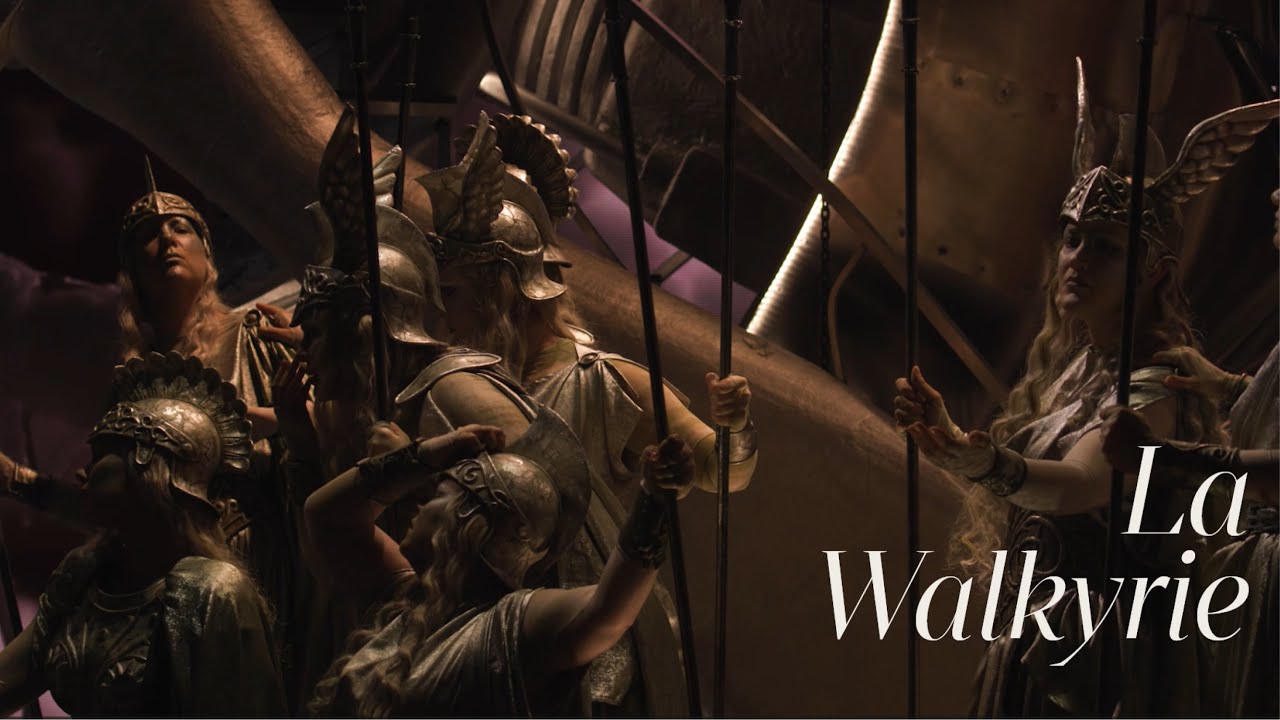
The Valkyries do their duty, accompanying dead warriors to Valhalla with a heroic horse procession. Joyful, they joke and tease the warriors and their mounts, while noticing the absence of their sister Brünnhilde. But when she appears, breathless, holding a mortal in her arms, they are stunned. Brünnhilde then recounts her adventures, begging her sisters to help her, but they refuse, fearing the wrath of their omnipotent father.
Brünnhilde has no choice but to entrust the broken pieces of the sword Nothung to Sieglinde and advise her to flee to the east, where the Nibelung treasure lies. There, she will raise her child safe from divine wrath. When this son has reconstructed the magic sword, he will triumph and succeed in overturning fate.
Wotan soon arrives and pronounces his sentence: for disobeying him, Brünnhilde will be stripped of her godly powers. She will no longer be a Valkyrie and will be condemned to eternal sleep, which only a mortal man can interrupt to wed her, making her a slave to his will. Terrified, Brünnhilde remains alone with her father. She tries to defend herself, explaining that she has only kept her original promise and that, thanks to her actions, the hero who will find the Rhine Gold and defeat the dwarves will be born.
Wotan hears his daughter's arguments and offers to lighten her punishment. She will be plunged into a deep sleep and placed on top of this mountain all the same, but to ensure the valour of her savior she must serve, he swears to surround her with an impenetrable circle of fire that only a true hero can brave. Brünnhilde's fate is sealed, and the stage is set for the third episode of this immense operatic saga: Siegfried.
Five facts to discover before the curtain rises
1
Die Walküre is one of four operas in a saga that is unique in the history of music: Der Ring des Nibelungen, more commonly called the Ring. This tetralogy draws on Norse mythology to fuel Germanic legends, in a rewriting effort worthy of the Greek and Latin authors who fascinated Wagner. Like Virgil and his Aeneid, the composer and author of his own librettos did not hesitate to rewrite history to offer the German people a new cosmogony.
2
Another monumental author was inspired by the Ring to write his life's work: JRR Tolkien. Just think: among other things, the Ring tells the story of a war between men, dwarves, gods, and giants for possession of a ring powerful enough to rule the world. In nearly 1,000 years, the myth has migrated from ancient Norse sagas to Hollywood sets, via German opera and heroic fantasy literature. A true saga within a saga...
3
While John Williams made the use of the leitmotif (a melody attached to each character, played when they appear on screen) famous with Star Wars, it was Wagner who invented it. He came up with the idea for two main reasons: firstly, to emotionally characterize a character through music in order to lighten the libretto, but also to help the audience recognize them among the crowd of protagonists that populate his work.
4
If the Ride of the Valkyries opening the third act sounds familiar, it's no coincidence: the score was used by Francis Ford Coppola to accompany the helicopters on mission in his film Apocalypse Now.
5
To produce his monumental operas, which required considerable staging resources, Richard Wagner needed the support of a powerful patron: King Ludwig II of Bavaria. But such help did not come without a price: the monarch, eager to discover his protégé's work, brought forward the date of Die Walküre’s premiere. Wagner protested, even calling the staging, which had been done without his knowledge, “rubbish,” and had to resign himself to seeing it performed as a single opera, when he had imagined it as part of a whole, performed in one go, in his life's work: the Ring.
MAÎTRES D’ŒUVRE
Direction musicale
Gianluca Capuano
Mise en scène
Davide Livermore
Décors
Eleonora Peronetti, Paolo Gep Cucco & Davide Livermore
Costumes
Gianluca Falaschi
Lumières
Antonio Castro
Vidéos
D-Wok
Assistant à la mise en scène
Diego Mingolla
Assistante aux costumes
Anna Missaglia
Assistant à la direction musicale
Benedikt Sauer
Chef de chant
Alessandro Pratico
SOLISTES
Siegmund
Joachim Bäckström
Hunding
Wilhelm Schwinghammer
Wotan
DANIEL SCOFIELD
Sieglinde
Libby Sokolowski
Brünnhilde
Nancy Weissbach
Fricka
Ekaterina Semenchuk
Helmwige
Sofia Fomina
Gerhilde
Natalia Tanasii
Waltraute
Maire Therese Carmack
Siegrune
Heike Wessels
Grimgerde
Anna Lapkovskaja
Schwertleite
Freya Apffelstaedt
Rossweisse
Niamh O’sullivan
Ortlinde
Kaarin Cecilia Phelps
ENFANTS
Angelica BASHNINA
Marcel Blanchard
Anastasia DE MARZIO
FIGURATION
Lisa CHIROL
Guillaume GALLO MANRIQUE
Hind Yasmine GUEFIF
Vladimir HUGOT
Léo LECARPENTIER
Timothée Martin Péguy
Emma TERNO
Artem USTINOV
Nicolas VITALE
LES MUSICIENS DU PRINCE-MONACO
General Manager
Margherita Rizzi Brignoli
Assistante de production
Mathilde Rollet
Régisseur
Nicolas Payan
Assistant régisseur
Ollivier Ballester
Premiers violons
Peter McGUIRE (leader)
Diego Moreno CASTELLI
Fabrizio CIPRIANI
Ágnes KERTÉSZ
Muriel QUISTAD
Roberto RUTKAUSKAS
Beatrice SCALDINI
Anaïs SOUCAILLE
Elena TELO
Andrea VASSALLE
Seconds violons
Nicolas MAZZOLENI (leader)
Ignazio ATZORI
Laura CAVAZZUTI
Francesco COLLETTI
Svetlana FOMINA
Reyes GALLARDO
Gian Andrea GUERRA
Massimo PERCIVALDI
Laura SCIPIONI
Altos
Anne Sophie VAN RIEL (leader)
Ilinca FORNA
Oscar HOLCH
Emanuele MARCANTE
Jonathan PONET
Bernadette VERHAGEN
Violoncelles
Robin Geoffrey MICHAEL (leader)
Nicola BROVELLI
Guillaume FRANCOIS
Candela GOMEZ BONET
Antonio Carlo PAPETTI
Emilie WALLYN
Contrebasses
Roberto FERNÁNDEZ DE LARRINOA (leader)
Jussif BARAKAT
Clotilde GUYON
Michele ZEOLI
Flûtes
Pablo SOSA DEL ROSARIO (leader)
Yat Ho TSANG
Reiko TSUIKI
Piccolo
Giulia Barbini
Hautbois
Pier Luigi FABRETTI (leader)
Aviad GERSHONI
Peter TABORI
Cor anglais
Guido CAMPANA
Clarinettes
Francesco SPENDOLINI (leader)
Roberta CRISTINI
Alejandro FARIÑA MARTÍN
Clarinette basse
Bernhard ROETHLISBERGER
Bassons
Benny AGHASSI (leader)
Hugo RODRÍGUEZ ARTEAGA
Eyal Binyamin STREETT REICH
Contrebasson
Hugo RODRÍGUEZ ARTEAGA
Cors d’harmonie
Thomas HAUSCHILD (leader)
Ulrich HÜBNER
Anton KOCH
Yannick MAILLET
Julian SCHACK
Elliot SEIDMAN
Julius WASSENAAR
Richard Che-Wei WU
Tubas wagnériens
Ulrich HÜBNER (leader)
Anton KOCH
Yannick MAILLET
Richard Che-Wei WU
Tuba basse
Harm Vuijk
Trompettes
Thibaud ROBINNE (leader)
Patrick Martin DREIER
Carlos HENRIQUES CORREIA
Trompette basse
Gabriele Marchetti
Trombones
Seth QUISTAD (leader)
Sverre RIISE
Trombone basse
Charlie Maussion
Trombone contrebasse
Gunter Carlier
Timbales
Sebastiano Nidi (leader)
Saverio Rufo
Percussions
Paolo NOCENTINI
Tommaso SALVADORI
Harpes
Markus THALHEIMER
Marta GRAZIOLINO
PERSONNEL DE SCENE
Directeur technique
Olivier Perin
Directeur de scène
Xavier Laforge
Régisseur principal
Elisabetta Acella
Régisseur de scène
Karine Ohanyan
Régisseur lumières
Léa Smith
Régisseur sur-titrage
Sarah Caussé
Régisseur enfants
Charline Amayenc
Laëtitia Estiot
Chefs machinistes
Olivier Kinoo
Yann Moreau
Chefs machinistes adjoints
Stephane GUALDE
Franck SATIZELLE
Peintre décorateur
Laurent Barcelo
Serrurier métallier
Schama Imbert
Techniciens de plateau
Heathcliff BONNET
Delphine BUCHWALD
Jean François CHOPIN
Morgan DUBOUIL
Nicolas MANCEL
Scott TASSONE
Camille TAULELLE
Pupitreurs machinerie
Tom AYRAULT
Samuel CHARIERAS
Jean-Philippe FARAUT
David M'BAPPÉ
Chef électricien et vidéo
Benoît Vigan
Chef électricien adjoint
Gael Le Maux
Pupitreurs lumières
Grégory Masse
Marie-Louise Suaud
Techniciens audio vidéo
Matteo Gesta
Felipe Manrique
Electriciens de spectacle
Harley BASILE
Gaspard BELLET
Guillaume BREMOND
Thibault CALIGARIS
Grégory CAMPANELLA
Florian CAPELLO
Ludovic DRUIT
Romain LA BARBERA
Baptiste MAGLIOLO
Jean Christian MEYER
Chef accessoiriste
Audrey Moravec
Chef accessoiriste adjoint
Franck Escobar
Accessoiristes
Landry BASILE
Roland BIREN
Nicolas Leroy
Chef costumière-habilleuse
Eliane Mezzanotte
Chef costumière-habilleuse adjointe
Emilie Bouneau
Habilleuse adjointe
Véronique Tetu
Habilleurs
Christian CALVIERA
Florence CHAPUIS RINALDINO
Mariam Chazaryan
Lili FORTIN
Edwige GALLI
Julie JACQUET
Karinne MARTIN
Lauriane SENET
Chef perruquière-maquilleuse
Déborah Nelson
Chef maquilleuse adjointe
Alicia Bovis
Coiffeurs
Corinne PAULÉ
Marilyn RIEUL
Maquilleurs
Margot JOURDAN
Sophie KILIAN TERRIEN
Agnès LOZANO
Francine RICHARD
Billetterie
Responsable billetterie
Virginie Hautot
Responsable adjointe billetterie
Jenna Brethenoux
Service billetterie
Ambre Gaillard
Dima Khabout
Assmaa Moussalli
The wind blows strongly, and a light mist floats on the threshold of Valhalla. On the vast plain, three figures appear: Brünnhilde, the Valkyrie, Sieglinde, the mortal girl, and Fricka, the protector goddess of marriage and morality.
Sieglinde: So, Brünnhilde, this Valkyrie story... what is it exactly?
Brünnhilde (with great pride): We, Valkyries, are the guardians of Valhalla. We are death warriors, called to guide fallen heroes to the home of the gods, where an afterlife of drink and merriment awaits them. Unlike the legends where we are thirteen, in Wagner's Ring we are nine. But behind this apparent glory, there is a heavy burden. It is often my duty to repair the chaos Wotan and his male offspring left in this world. o restore balance to the world, I am willing to sacrifice my life if necessary.
Fricka (interrupting, offended): Balance? Don't talk to me about "balance," Brünnhilde! Wotan made you his puppet, a creature of war! And you, Sieglinde... (she turns to the young mortal) You were born from infidelity! Wotan betrayed me! And yet, the two of you think you have any legitimacy?!
Sieglinde: So... If I understand correctly, you're saying that Brünnhilde and I are half-sisters? And that you, Fricka, would be... both my stepmother and my mother-in law?
Fricka (her voice trembling with anger): I am his wife, the protector of wedlock and morals! You both are the fruit of his weakness, his mistakes, his unbridled desire. By creating you, he broke the universal order and violated the laws of morality. And you, Brünnhilde... (she stares at the Valkyrie with a piercing gaze) You are nothing but an instrument in his power games. Do you really think that, by rushing to his rescue, you will restore balance? No! You're only fuelling the anarchy he has sown. The two of you... You are the paving stones of the path to his destruction.
Brünnhilde: Are you so sure, Fricka, that the order you defend is the one that will save the world? Wotan himself is no longer sure of his actions. That’s why I’m here. Yes, I’m engaged in this war so that the world can find its balance again. My destiny is tied to that of men... and perhaps destruction will allow for a renewal that will reveal the truth.
Sieglinde: But deep down, if Wotan is our creator, if love and war mix in such a whirlwind... who are we to judge what is right or wrong?
Fricka: It is not for you to decide what is right. You are instruments of destabilization. You, Brünnhilde, you talk about sacrifice, but who benefits from this sacrifice? Not the order of the world, not the purity of marriage, not the morality I defend!
Brünnhilde (sighing): Order... Purity... These words no longer mean anything, Fricka. We are far from the gods we used to know, far from the perfection you seek to preserve. The universe is no longer what it was. Men and gods are all prisoners of their own weakness. And perhaps it is only by crossing through chaos that we may hope to find some form of salvation.
Sieglinde: It's strange, really. I was thrown into this world without understanding everything it entails. A brother, a sister, a father... forbidden loves, endless struggles. What am I to do with this? What does it mean for me, as a human being, to carry such a legacy?
Fricka (in an accusatory tone): It means you were born to destroy everything, to follow Wotan and his male offspring’s missteps. And I will do everything to prevent that.
Brünnhilde (with a bitter smile): Perhaps, in all this chaos, there is a meaning we do not yet see. Perhaps sacrifice is our only path to possible redemption...
Sieglinde: But then, where is the freedom in all of this?
Galerie images


