


Offenbach La Vie parisienne
Saturday 26 December 2026 - 20 h
Sunday 27 December 2026 - 15 h
Tuesday 29 December 2026 - 20 h
Thursday 31 December 2026 - 18 h
Comic opera in five acts
Music by Jacques Offenbach (1819-1880)
Libretto by Henri Meilhac and Ludovic Halévy
Premiere: Paris, Théâtre du Palais-Royal, 31 october 1866
The complete original edition of 1866
Co-production: Bru Zane France / Opéra Royal de Wallonie-Liège / Opéra Orchestre Normandie Rouen / Théâtre des Champs-Élysées / Opéra Orchestre national Montpellier Occitanie / Opéra de Limoges / Opéra de Tours / Palazzetto Bru Zane
Executive production: Bru Zane France
Set design, costumes, props and wigs created by the workshops of the Opéra Royal de Wallonie-Liège
Music published by Palazzetto Bru Zane
Talking about les amours impossibles: A myth emerging in the 19th century suggested that everything (un)imaginable in that sector was possible in Paris. Allegedly, this notion was triggered by rich American men starting to discover Europe for themselves, far from the observing eyes of their puritan mothers and brides. But all was not that simple, as we are told in La Vie parisienne.
Bobinet and Gardefeu, two Parisian dandys, play all sorts of tricks to win the favours of Métella, a demimondaine, while getting rid of her latest admirer, the Baron de Gondremarck, newly arrived to Paris with his wife. However, the shrewd Baroness and her friends delude and shamefully expose their play.
With its frivolous depiction of local nightlife, La Vie parisienne became immensely popular when premiered shortly before the 1867 Paris Exposition, whereas the libretto’s satirical comments on current military and political affairs were immediately censored. We present you La Vie parisienne in its uncensored version with a magnificent, idiomatic Francophone cast and in a splendidly colourful staging by Christian Lacroix, which ends, as Offenbach wished, in merriment, champagne and song.
Les Musiciens du Prince - Monaco
- TIDGY CHÂTEAU
- EMILIE ELIAZORD
- LILI FELDER
- PAUL GOUVEN
- KARINE ORTS
- ELISA RIBES
- ARTHUR ROUSSEL
- GUILLAUME ZIMMERMANN
Act I
Raoul de Gardefeu and Bobinet belong to that agreeable class of young men for whom life offers an abundance of diversions but very little purpose. They have lately suffered the same mortification. Métella, a celebrated beauty of the demi-monde, has accepted the devotion of each in turn with an impartiality that wounds their vanity more than their hearts. In the first irritation of disappointment they declare themselves weary of easy conquests and resolve to devote their attentions to respectable women, whose reluctance promises a more gratifying triumph. Fortune, which so often lends itself to the idle, soon provides Gardefeu with an opportunity. At the station he encounters Baron and Baroness de Gondremarck, newly arrived from Denmark and eager to discover the marvels of Paris. The Baroness possesses that freshness of perception which survives only until experience has taught suspicion. Gardefeu, whose confidence is equal to any emergency, introduces himself as a guide attached to the Grand Hotel. The strangers accept his assistance with grateful simplicity, little imagining that they just entrusted themselves to a man whose chief talent lays in trickery.
Acte Ii
Gardefeu leads his guests to his own residence, which they accept without question as a discreet extension of the hotel. The Baron, whose tastes incline more readily toward pleasure than culture, asks his obliging guide to arrange a clandestine meeting with a lady whose attractions have been warmly recommended to him. The lady is none other than Métella. Having settled this delicate matter, he announces that he wishes to dine at a table d'hôte, believing it an indispensable feature of Parisian life. Gardefeu meets the difficulty with characteristic resourcefulness. His bootmaker, Frick, his glove-maker, Gabrielle, and a handful of acquaintances are persuaded to assume the appearance of distinguished guests. Frick becomes a major with astonishing ease; Gabrielle carries herself with the composed dignity of a colonel's widow. The remaining conspirators, dressed as boiterous Germans or exuberant Marseillais, complete a society whose respectability rests entirely upon costume and cockiness. It is remarkable that the deception succeeds, though perhaps no more remarkable than the readiness with which gullible people accept appearances when those appearances flatter their expectations.
Act Iii
Bobinet, meanwhile, has conceived an undertaking no less extravagant. At his aunt's hôtel particulier he arranges a magnificent ball whose brilliance depends entirely upon a hoax. The Baron has to be separated from his wife so that Gardefeu may pursue his attentions without interruption. The servants enter into the masquerade with unexpected enthusiasm. For one evening they exchange livery for evening dress and perform the manners of the fashionable world with an enjoyment that suggests how thin the barrier between the two conditions could sometimes appear. Pauline, the maid, displays so engaging a charm that the Baron almost forgets the object of his visit to Paris. Bobinet himself appears in the magnificent and wholly wacky uniform of a Swiss admiral. Supper is announced just as Frick and the rest of the improvised company arrive, every one of them carrying a borrowed dignity with perfect assurance.
Act Iv
The following day brings the first consequences of these agreeable inventions. Madame de Quimper-Karadec and her niece, Madame de Folle-Verdure, return to find Baron de Gondremarck comfortably installed in the house, as though his presence required no explanation. Pauline supplies one with admirable composure, introducing him as her fiancé, Jean the coachman, and speaks so naturally of the festivities they had supposedly shared that contradiction seem almost ill-mannered. The Baron, still bewildered by events he has never quite understood, withdraws to prepare for a dinner to which he and his wife have been invited, unaware that the invitation leads him to the very house in which he stands. Soon afterward the Baroness arrives with Bobinet and Gardefeu. She calmly produces a letter from Métella in which the entire intrigue is revealed with malicious precision. The celebrated beauty announces that she intends to resume the place she had formerly occupied in the Baron's affections, leaving Gardefeu to discover that even his imagined successes are founded upon illusion. When the Baron reappears, concealment becomes impossible. The carefully sustained falsehoods dissolve almost at once. Every disguise loses its purpose, every pretence its usefulness. Yet the conspirators, finding the truth no less amusing than the deception, abandon themselves once more to laughter, as though the spirit of the masquerade survived the disappearance of the masks.
Act v
The adventure reaches its conclusion at one of those celebrated restaurants where Paris nightly congratulates itself upon being Paris. Bobinet and Gardefeu accept an invitation to a costume party given by a wealthy Brazilian. Gardefeu, reflecting upon the unhappy conclusion of his schemes, almost regrets the society of the demi-monde. Its conventions, however capricious, now appear simpler than the uncertainties of virtue. Among the masked guests appears Madame de Quimper-Karadec, Madame de Folle-Verdure, and the Baroness. Behind the scenes Métella continues, with effortless authority, to direct the movements of everyone concerned. It is she who has summoned the Baroness, determined that Gondremarck's affections should return to their former channel. When the Baron is at last reunited with his wife, he promises that they will leave Paris the following day and return quietly to Copenhagen. Thus the affair ends as such affairs generally do: no one has obtained quite what they desired, yet everyone is relieved to abandon the pursuit. Resentment dissolves into good humour, and Paris, indifferent to the follies it inspires, prepares without remorse to furnish fresh illusions for the next arrivals.
Five facts to discover before the curtain rises
1
This version of La Vie parisienne is the result of extensive editorial work, in which the score – which in reality never existed in a ‘final’ form – has been throroughly restored. Right from the very first rehearsals, Offenbach began to alter the content for reasons that were as varied as they were compelling: the ‘censorship’ libretto riddled with crossed-out passages; singers who, due to their shaky vocal abilities, were unable to take on this or that role; or changes to the plot to make the story more exciting. A few days after the premiere of the five-act version in October 1866, Offenbach did not hesitate to alter arias and ensembles to ensure the fluidity of the plot, whilst the 1873 version comprises only four acts, with more or less extensive revisions on every page compared to the first version: characters added or removed, arias and ensembles shortened or rewritten, plot lines jumbled up … La Vie parisienne will forever remain a ‘work in progress’.
What you are hearing here is a version that revives many of the elements discarded in the early decades, featuring the ‘censored’ libretto in its original form, which contains all the audacious elements so highly prized at the time – particularly in the dialogues, which are far more extensive and risqué; not to mention the arias, ensembles and orchestral interludes that were set aside but have been restored here from all available sources, some of which have only recently been rediscovered.
2
The Prince of Wales, Napoleon III and Empress Eugénie, as well as the Russian Tsar Alexander II, were among the work’s greatest admirers, who, together with tens of thousands of enthusiastic spectators, made sure not to miss it. It must be said that between the world premiere in 1866 and 1889, no fewer than 323 performances took place in Paris alone, plus hundreds more in Marseille, Rouen, Lille, Lyon, Nantes and, later, in Brussels, Vienna, Berlin, Algiers and New York – in short, all over the world. Its success remained unbroken throughout.
3
Nowadays, theatres often have no choice but to devise their own version from one production to the next, or to revive an earlier production more or less unchanged. Some companies prefer to focus on the text and the comedy, as the Compagnie Renaud-Barrault did in a famous 1958 production: Almost no character was played by ‘real’ singers, but rather by famous theatre actors with varying degrees of vocal ability, such as Jean-Louis Barrault himself, Madeleine Renaud, Simone Valère, Suzy Delair, Jean Desailly and Jean Parédès. This is one of the most whimsical, least vocally focused interpretations ever – and yet it was a smashing success.
4
In the final act, Jacques Offenbach pays a moving tribute to Mozart by introducing a parody of the first finale of Don Giovanni – in which Mozart parodies himself by borrowing from his own operas! A fitting tribute to the Viennese master from Offenbach, whom Rossini himself, incidentally, had described as ‘the Mozart of the Champs-Élysées’.
5
La Vie parisienne is an opéra-bouffe. What is the difference between opéra-bouffe, operetta and opéra-comique? The term opéra-comique refers to a work (which, incidentally, need not necessarily be comic: the tragic operas Carmen by Bizet or Manon by Massenet are opéras comiques, keepoing in mind that ‘comique’ etymologically refers to ‘pertaining to the theatre’), in which sung passages alternate with spoken dialogue; it is generally regarded as the most musically and dramatically sophisticated form. The opéra bouffe was immortalised by Offenbach; it is a variant of the opéra comique with a distinctly parodic, farcical and mocking tone, in which social conventions and deities are readily ridiculed. The operetta (French style) emerged during the Second Empire; it is a shorter and lighter version of the opéra bouffe. It resembles vaudeville and serves no other purpose than to entertain. It differs considerably from the Viennese operetta, which is more expansive in scope, more sentimental and focuses on the waltz and romantic intrigues.
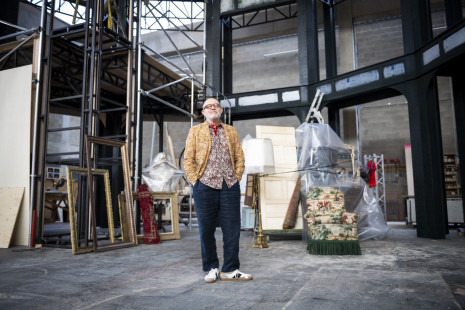
Do you see the stage as a natural extension of the catwalk, or as an entirely different form of expression?
I would actually say the opposite: the Haute Couture runway was an extension of the stage, since from the 1980s onwards I became both a costume designer and a fashion designer at the same time. Fashion was merely a rather unexpected detour along my path. Ever since childhood, I have been drawn to performance in all its forms. I have always regarded my clients as heroines, the leading ladies of their own lives, whose stories often belonged to the worlds of cinema, theatre or opera. Each collection was rather like a novella, a short film, or a fairy tale.
Behind Offenbach's light-heartedness and humour lies a sharp critique of the society of his time: do you think this dimension is still relevant – or necessary – for today's audience?
I was surprised by how relevant certain passages in the libretto still are and seem to refer to modern-day Paris. Offenbach’s criticism is therefore clearly visible and audible, and the audience’s reaction confirmed this, not only in Paris, incidentally. This vision of a capital city that has become a kind of theme park for tourists still resonates with us today. However, I do not feel the need to emphasise this point further, and prefer to remain allusive. I merely hint at the endless construction work in the capital through elements from contemporary building sites in the sets for the first act.
For me, sets, costumes, wigs and all the other visual elements are part of the pleasure of going to the theatre. Yet for the past fifty years or so, there has been an almost compulsive urge to transpose every great play and opera into the present day, dressing everyone in business suits and placing them in bank-like interiors inspired by Wall Street or kitsch housing estates. To my mind, this sometimes strips works—particularly those of Offenbach—of part of their charm and distinctive flavour. I therefore chose simply to sprinkle the sets and costumes with a subtle touch of the twenty-first century, enough to evoke life in today's Paris, while embracing an openly bouffe spirit rather than a contemporary one.
Offenbach handles irony, excess and lightness with great precision. Does this musical and theatrical spirit influence your staging?
It is essential to follow Offenbach's musical and theatrical spirit to the letter, to let ourselves go because he guides us. As we pay attention to the libretto and the score, images emerge and the flow of the staging takes shape. It imposes itself as if it were taking us by the hand.
Your La Vie parisienne brings nineteenth-century Paris into dialogue with a strikingly contemporary vitality. Where, in your view, does the line lie between fidelity and reinvention?
As I mentioned earlier, something about Offenbach's era remains timeless and still speaks to our own: attitudes, emotions and human foibles that never really change. The challenge is to work within the space that connects 1866 - the year of the premiere - to 2027, linking Offenbach's characters with our contemporaries, without becoming trapped in strict historical fidelity that leads only to a lifeless reconstruction, or feeling compelled to relocate the action to another period.
Although I was born a century after Offenbach first emerged on the Parisian scene in the mid-nineteenth century, his music was very much part of the landscape of my childhood. My great-grandmothers, whom I had the privilege of knowing, could well have crossed paths with him. They had heard his music in their youth. As someone who is unabashedly nostalgic, deeply attached to the past, and an incorrigible historian of costume, I have always been fascinated - among many other periods - by the era of Napoleon III: the great World Fairs, the theatres along the famous Boulevard du Crime, the crinolines... I spent countless hours poring over newspapers and magazines discovered in my grandparents' attic.
Your staging creates a very distinctive visual universe: between deliberate references and creative freedom, what were the cornerstones of this imaginary world?
This was my very first time directing, and just like when I started sewing without any training, I told myself that I should only follow my instincts, my convictions, the “small voice” inside me, without looking left or right. I think that giving pleasure to others starts with giving pleasure to yourself, without restriction; it’s hit or miss, but it’s also the best way to avoid regrets or remorse.
My very first idea was to have La Vie parisienne sung and acted in a somewhat melodramatic vein, subtly emphasising the social criticism embedded in the work and deliberately going against the grain of productions of Offenbach that, to my taste, often lean too heavily towards light entertainment. Very quickly, however, I realised how artificial that approach felt so I chose a world that was not tragicomical but closer to the world of circus. In circus, you can exaggerate certain moments, like clowns do when they start to speak, whereas free rein is given to the poetry of acrobats and contortionists, or the imaginativeness we see in trained animal acts.
Late nineteenth-century Paris saw the rise and flourishing of countless circuses, and it is that atmosphere which underpins the entire production: the ring, the festoon lights, the stripes, the slightly grotesque exaggeration, the nocturnal atmosphere, the make-up, the wigs, the extravagant checked and polka-dot costumes, the ringmaster in tails and top hat, imaginary exoticism, but also the magic of conjurors, tightrope dancers and so on. It is this circus universe that I chose as a link, a common ground between Offenbach and myself.
Throughout your career, you have explored the relationship between costume and identity. How did this expertise translate to the stage and its dramaturgy, particularly in La Vie parisienne?
I believe my imagination has always been populated by archetypes that I have constantly reinterpreted in my own way: fairy tales and legends, rituals and traditions, icons and the commedia dell'arte... A vast repertoire, a space beyond time, an inheritance from which I draw to create my own theatre - the theatre of fashion, the stage and life itself.
These are the archetypes I have reimagined here. They are inspired by period caricatures, such as those found in nineteenth-century newspapers and posters, and they clothe each character - and the chorus - as I imagined them while listening to the score, summoning the worlds and creatures that have inhabited my imagination ever since childhood.
A production of Offenbach also requires a measure of childlike wonder, together with a certain adolescent romanticism, while never forgetting the cynicism - or perhaps the clear-eyed pessimism - that comes with adulthood.
How did you approach shaping the caustic characters of La Vie parisienne?
With the more caustic characters, as with all the others - including the chorus - I constantly moved back and forth between the image suggested by the score and reality: the singers' physical presence, their facial expressions, the way they move.
I always dread the moment when I have to imagine and sketch costume designs for actors, dancers or singers whom I have not yet met. The costumes must fit each performer as closely as possible in order to help them inhabit their character. It is bespoke tailoring in every sense: physically, mentally and spiritually.
In this case, I already knew some of the performers from previous collaborations, which was both inspiring and immensely helpful. I also hope that the deliberate emphasis on exaggeration and caricature has enabled each of the different casts we have worked with since the production premiered in 2021 to slip naturally into the skin of their characters.
Finally, during the first rehearsals, I encouraged everyone to express their own personalities freely - to bring forward their ideas, their improvisations and their natural instincts. As a newcomer to directing, I was fortunate to rely on directors Romain Gilbert and Laurent Delvert, who helped channel all of this and shape the actors' work from the guidance I had provided.
What do you hope audiences in Monaco will take away from your La Vie parisienne?
I don’t know the Monegasque audience yet, but as everywhere else we’ve been, I dare to hope that the pleasure I took in creating this version of La Vie parisienne will be palpable, as well as everything that each singer, dancer and chorus member shares with them every night.